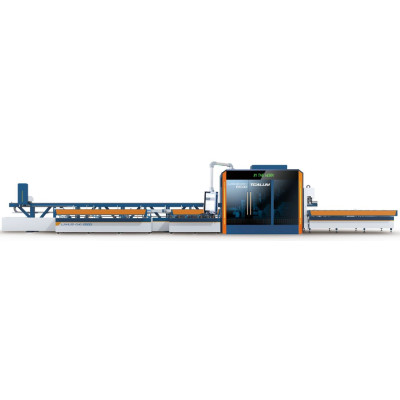
TIANCHEN X-280. Combined Laser Cutting and Machining Center for Aluminum. For windows, doors, portals, and facades.
Features
☆ The center consists of three main zones: a loading zone, a machining zone, and an unloading zone.
☆ The machining zone includes two independent units: a drilling and milling unit and a cutting (sawing) unit.
☆ Equipped with reinforced supports for cutting and milling operations.
☆ Capable of cutting and milling frames to achieve specific geometric configurations.
☆ Capable of cutting and milling extra-wide profiles.
☆ Suitable for drilling and milling holes and slots on all four sides of aluminum profiles used for windows, doors, and facades, while also enabling efficient cutting.
☆ Highly efficient, continuous processing of corners and profile end-joint depths through integrated composite machining.
☆ This aluminum profile processing system can efficiently and continuously perform combined machining at angles of 45°, 90°, and 135°. It also supports cutting at any angle within the 45° to 135° range.
☆ The drilling and milling unit is positioned on the feed side, with high-power milling spindles located above, below, in front of, and behind the profile. A laser marking head is mounted on the front, and a laser cutting head is mounted on the rear.
☆ The four high-power milling spindles are equipped with X, Y, and Z-axis servo drives. The X-axis servo drive provides an extended milling range, enabling synchronized machining of four-sided holes and slots, as well as milling and saw-blade cutting operations.
☆ In addition to the X, Y, and Z servo-driven axes, the front-mounted electric spindle features a dedicated fourth rotary servo axis. This allows for automated machining that can navigate around specific features, such as concealed drainage holes, air-pressure balancing vents, and drainage slots.
☆ Saw blades are positioned on both the top and bottom of the machine head, facilitating end-cutting of profiles and the machining of bottom-end joints—a configuration particularly well-suited for processing the angled joints of transoms (mullions).
☆ Two electric spindles are mounted on the top side. One of these spindles is capable of angular adjustment and can be equipped with a T-slot drainage milling cutter, allowing for the creation of inclined drainage slots in transom profiles.
☆ The drilling and milling unit is positioned parallel to the laser system along the same X-axis coordinate, simplifying the selection between laser processing and mechanical milling.
☆ Both the milling cutter and the laser cutting head are oriented toward the rear reference surface, supporting horizontal (0°) machining as well as 10° (or 15°) inclined processing; this also enables the system to automatically avoid specific features, such as angled pin holes.
☆ The worktable features a fixed rear reference surface used for clamping and positioning profiles during cutting and machining, ensuring maximum precision in both sawing and profile processing. ☆ The worktable features a horizontal movement function that works in tandem with the saw head to facilitate the discharge of offcuts, end pieces, and scrap, ensuring a smooth material unloading process. Furthermore, this prevents the material from being dragged or scraped during the saw head's return stroke, thereby extending the service life of the saw blade.
☆ The horizontal movement of the worktable, combined with the saw head, enables the cutting of profiles—such as those used for fan-light corners—with high precision.
☆ The worktable is equipped with an air-supply system designed to clean and cool the underside of the profile, while simultaneously enhancing positioning accuracy.
☆ The feeding unit includes a specialized clamping/alignment feature for narrow profiles, allowing for the stable feeding and cutting of thin, tall, or otherwise unstable workpieces.
☆ The drilling and milling unit features a compact design, enabling processing with minimal profile overhang.
☆ A maintenance access aisle is provided between the drilling/milling unit and the feeding mechanism, simplifying tool changes and routine maintenance.
☆ The integrated design includes a centralized vacuum and chip-removal system, which effectively contains aluminum chips and offcuts, ensures the separation of scrap from finished parts, and maintains a clean production environment.
☆ The system can be configured with an automatic barcode (or QR code) printing and labeling unit, enabling automated profile identification and supporting the implementation of a digital "E-Work" factory system.
☆ All moving components are equipped with high-precision linear guides, ensuring smooth operation and consistent machining accuracy.
☆ The feeding manipulator is driven by a servo motor for precise, automated control.